
Buying Rental Cars at Auction: Risks, Rewards, and Red Flags


- Buying Salvage Work Vans for Small Businesses: Sourcing Trades Vehicles on a Budget - September 29, 2026
- Missing Catalytic Converters on Salvage Auction Cars: What Buyers Need to Know - September 25, 2026
- 9 SUVs With the Best Gas Mileage to Look for at Salvage Auctions - September 22, 2026
Cars sold by rental companies are another category of used vehicles available through auctions. These vehicles typically become available as companies rotate newer vehicles into their fleets. Other reasons rentals may end up at auction include shifting market demand, high mileage, or attempts at recouping losses (such as accident damage).
Buying rental cars at auction isn’t inherently good or bad. Buyers can use rental auctions to potentially find newer vehicles, popular models, and automobiles with better maintenance.
Used vehicles at auction can come with uncertainty, but rental companies typically have strict fleet maintenance requirements. Low auction pricing is another significant perk.
However, maintenance history and price alone don’t define whether an ex-rental car for sale is worth it. Instead, you’ll need to consider a lot’s history. Alongside maintenance, this history includes factors like mileage, damage, and title status.
Below, we’ll explore rental vehicle auction benefits, risks, and red flags so you can bid with confidence.
Key Takeaways
- Rental vehicle companies often auction off inventory they’re cycling out because it’s faster than selling cars individually.
- Determining whether a rental car auction is worthwhile begins with reviewing primary listing information. Key listing information includes the vehicle’s title group, title code, primary damage, odometer, run and drive status, photos, and vehicle history.
- Title groups categorize a vehicle’s title status in plain language.
- Listing information and vehicle history reports shouldn’t replace an in-person inspection.
- Your maximum bid should be your total budget minus expected costs beyond winning. Set an all-in maximum budget before bidding.
- Not knowing an ex-rental car’s primary damage can put you at risk of underestimating its total acquisition cost.
| Rental Car Auction Detail | What It Tells You | Why It Matters |
| Title Group | The vehicle’s general title status | Helps you understand whether the title is clean, salvage, nonrepairable, or otherwise branded |
| Title Code | The issuing state and title type | Gives you context about the vehicle’s title paperwork |
| Primary Damage | The main reported category damage | Helps you anticipate potential repair needs and costs |
| Odometer | The displayed mileage and its designation | Helps you determine how much confidence to place in the listed mileage |
| Run and Drive | Whether the vehicle started, shifted, and moved under its own power during evaluation | Provides useful condition information, but doesn’t confirm mechanical soundness |
| Photos | The vehicle’s visible condition | Can reveal damage or defects not fully described in the listing |
| Vehicle History | Prior sale, accident, theft, title history, and other available records | Provides additional context on a vehicle’s history |
Understanding Rental Cars at Auction
Rental fleets range significantly in size. Regional operator fleets might consist of hundreds to several thousand vehicles. In comparison, worldwide brands like Enterprise have more than 900,000 cars in the U.S. and Canada alone.
Car rental companies want to make room for new inventory or recoup losses as fast as possible. Subsequently, they often use wholesale auctions to offload inventory faster than selling vehicles individually.
While rental fleet vehicle auctions can contain damage, they’re generally different from vehicles being auctioned solely because of collision or insurance claims. A rental auction label notes previous use, not necessarily condition or title status.
An individual vehicle’s details matter more than its rental auction label, given the many reasons fleets discard their rental cars.
AutoBidMaster’s dedicated rental-vehicle inventory helps you evaluate essential bidding, including but not limited to:
- Primary damage
- Key status
- VIN details for history reports
- Auction title code
- Title group
- Odometer
- Run and drive status
We’ll later explain why knowing this information increases your chances of a worthwhile ex-rental purchase.
The Potential Rewards of Buying a Rental Car at Auction

Have you ever wondered if rental cars are good to buy?
If so, you might assume that former rental cars have experienced heavy use and may not be worth considering. In reality, buying used rental cars can offer several advantages.
Common benefits of buying retired rental cars include relatively recent model years, popular make availability, better maintenance history, and competitive pricing.
Companies often don’t hold onto rental inventory for more than two years. As a result, you can often find newer cars for less money at auction than the private market.
Fleets also want inventory that attracts customers. This approach prioritizes the most popular vehicle segments, models, and features. A sudden market shift in driver preferences may lead to your preferred model being auctioned.
Maintenance is one of the most significant aspects of buying used. Rental car companies often have strict maintenance practices for their fleets.
In comparison, some drivers have a habit of prolonging routine maintenance. While these practices are vital for any driver, untimely maintenance is an especially significant fleet liability.
Poorly maintained vehicles have a higher risk of breakdown, which can lead to significant repair costs and a poor customer review. Even if a rental car doesn’t break down due to a lack of maintenance, skipping service intervals can increase wear and tear, accelerate vehicle aging, and reduce overall driving satisfaction.
Ultimately, private owners are less incentivized to complete timely maintenance than fleets.
Rental Car Auction Risks You Should Understand
Just as there are potential online auto fleet auction benefits, there are risks.
As previously mentioned, a rental auction label isn’t enough by itself to properly evaluate a listing. The lot’s other fields will tell you much more.
Let’s take a closer look at what these fields mean.
Title Group and Title Code
Not checking title group and title code information can leave you unclear about a listing’s title status and paperwork.
Title groups categorize vehicle title statuses in plain language. Bidders can use title group information on AutoBidMaster to quickly understand a listing’s overarching condition and export or registration requirements.
For example, a lot’s title group might read, “Clean Title (may become salvage per NMVTIS [National Motor Vehicle Title Information System]).”
You shouldn’t assume a rental vehicle auction means the car’s title is clean; we handle that clarification. Other common title types include salvage or nonrepairable.
In comparison, a title code indicates the issuing state and type of title document.
An auction title code showing a vehicle from Texas with a certificate of title document would read, “TX – Certificate of Title.”
Primary Damage
Not knowing a listing’s primary damage can make it harder to estimate the car’s total acquisition cost.
Primary damage severity varies. A vehicle that a rental company is cycling out might have normal wear or minor dents and scratches cited as its primary damage.
Another rental car salvage auction listing may have more significant primary damage like front-end or all-over damage.
Note that an AutoBidMaster listing’s primary damage is a starting point rather than a complete diagnosis.
Odometer
Odometer mileage helps determine a vehicle’s condition, but you should also consider its designation. Only looking at the odometer number can lead to misinterpreting the vehicle’s actual mileage.
These designations include:
- Actual
- Not Actual
- Exceeds Mechanical Limits
- Exempt
“Actual” means the mileage is believed to be accurate. Mileage designated “Not Actual” signals that the number is either incorrect or irretrievable.
“Exceeds Mechanical Limits” communicates that the car’s true mileage has passed the odometer’s highest measuring capacity. Lastly, “Exempt” mileage means that federal law doesn’t require an odometer code.
Run and Drive
A “Run and Drive” label indicates that the rental vehicle started at the time of evaluation, could shift gears during the test, and moved under its own power.
Some mistakenly assume that a vehicle is mechanically sound based on a “Run and Drive” designation.
Evaluating U.S.A. Rental Car Auction Listings: Additional Considerations
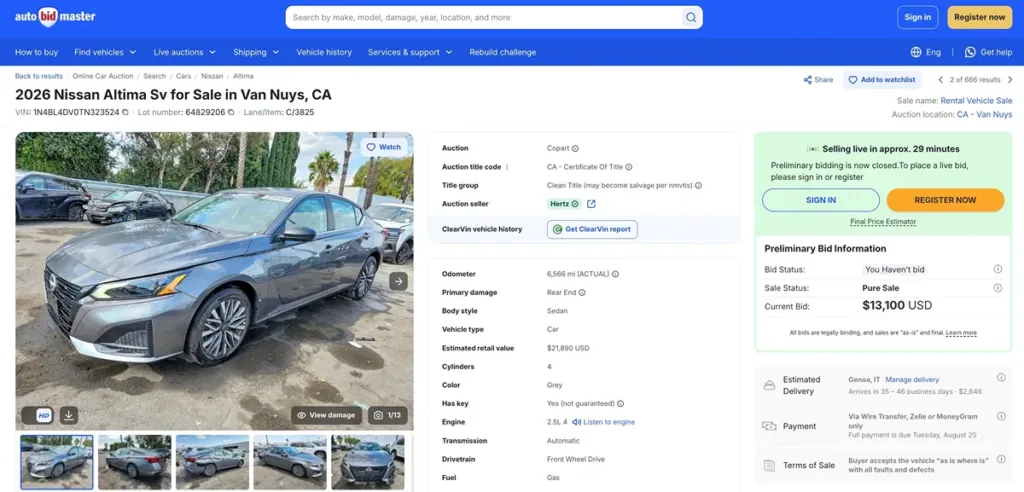
It’s easier to identify rental car buying red flags when you approach listings like an evaluator. Photos are typically your first inspection layer.
Basic lot information like title status and primary damage type can help you focus on areas where damage is described. You want a listing’s images to cover all angles, be clear, and be well-lit.
Photos can also raise questions that the lot’s text doesn’t answer. For example, a particular lot’s primary damage might be listed as minor dents and scratches. However, when you review the car’s images, you might notice other defects like panel gaps or broken lights.
We help you fill in the blanks of basic lot information with convenient ClearVin vehicle history check access. Ordering a ClearVin report can inform you of a vehicle’s sale history, theft records, accident history reports, and more.
While listing and ClearVin information is helpful, it shouldn’t replace a used rental car inspection. Organizing an inspection allows you or a third party to potentially reveal rental car auction hidden damage and verify the information you’ve read online.
Calculate the Real Cost Before You Bid
A listing’s current bid isn’t the final purchase cost.
You should set a maximum bid after accounting for:
- Auction fees
- Taxes
- Transportation
- Storage and late pick-up fees (if applicable)
- Repairs and immediate maintenance
- Title and registration costs (if applicable)
Your maximum bid should be your total budget minus expected costs beyond winning. Set an all-in maximum budget before rental car fleet buying.
Conclusion: Rental Car Auction Pros and Cons
Buying a former rental vehicle at auction isn’t inherently good or bad. Instead, your results depend on the auction lot’s specifics and your budget.
The advertised details within a listing outlined below are good jumping-off points for establishing former rental car value:
- Primary damage
- Title group
- Title code
- Odometer information
- Run and drive status
However, a ClearVin report and inspection will give you a better sense of a listing’s worth. A quality listing should have a suitable title, transparent damage and condition details, credible mileage, adequate history, and a price leaving room for post-bidding costs.
Follow these rental vehicle auction tips to increase your odds of walking away with a worthwhile AutoBidMaster purchase.
FAQ
Do rental cars have higher mileage?
Rental cars at auction can have higher mileage on average than privately owned vehicles.
While former rental cars tend to accumulate miles faster, they often have strict maintenance schedules that private owners may not follow.
How long do rental cars stay in service?
Rental cars typically stay in service for no more than two years.
A rental company might cycle out existing inventory due to age, mileage limits, or market patterns, such as lower demand for a particular model.
Can rental cars at auction have salvage titles?
Yes, former rental cars at auction can have salvage titles.
You can verify whether an ex-rental up for auction has a salvage title under an AutoBidMaster lot’s title code and title group information.
Sources (accessed August, 2026):
- CarPro — Advice: Should You Buy A Former Rental Car?
- Automotive Fleet — Enterprise Fleet Management Surpasses 900,000 Vehicles in U.S. & Canada
- RENTALL Software — How long do rental car companies keep their cars?