
Top-Selling Car Brands in the World: 2025 Sales Rankings and 2026 Trends
Table of Contents
Toyota Group has topped global vehicle sales for six years in a row. That kind of consistency is hard to ignore, but the more interesting developments in 2025 happened further down the rankings. BYD moved ahead of Ford in reported group sales to take sixth place in a widely cited global comparison. Tesla’s leading models lost ground, while hybrids—once widely viewed as a temporary step toward full electrification—proved that buyers still wanted them.
Here’s a closer look at the global market and what these sales figures can tell you if you’re planning to buy a used vehicle.
Key Takeaways
- Toyota Group led global sales in 2025 with 11.32 million vehicles, up 4.65% year over year.
- Volkswagen Group held second place with 8.98 million units, a slight decline from the prior year.
- BYD reached 4.6 million units and moved past Ford, pushing the American manufacturer out of the global top six for the first time.
- BYD also overtook Tesla as the world’s largest battery-electric vehicle seller, with 2.26 million BEVs sold.
- Based on the dataset used for this comparison, the Toyota RAV4 ranked as the world’s best-selling individual model in 2025, displacing the Tesla Model Y, which declined by roughly 9% to 11%.
- In the United States, the Ford F-Series remained the top seller at 828,832 units.
- Hybrid demand drove much of the year’s movement, particularly for Toyota and Honda.
Global Car Brand Rankings by Sales Volume: Top 10 Groups in 2025
This ranking compares automotive groups rather than individual brands and uses reported 2025 global sales figures from the sources listed below.
| Rank | Group | 2025 Sales | Notable Brands |
| 1 | Toyota | 11.32M | Toyota, Lexus, Daihatsu, Hino |
| 2 | Volkswagen | 8.98M | VW, Audi, Skoda, Porsche |
| 3 | Hyundai Motor Group | 7.27M | Hyundai, Kia, Genesis |
| 4 | General Motors | ~6.18M | Chevrolet, GMC, Cadillac, Buick |
| 5 | Stellantis | 5.48M | Jeep, Ram, Peugeot, Fiat |
| 6 | BYD | 4.60M | BYD, Denza, Yangwang |
| 7 | SAIC | 4.51M | MG, Roewe, Maxus, Baojun |
| 8 | Ford | 4.39M | Ford, Lincoln |
| 9 | Geely Group | 4.12M | Geely, Volvo, Polestar, Lotus |
| 10 | Honda | 3.46M | Honda, Acura |
One important caveat: reported figures vary between analysts depending on whether they count commercial vehicles, joint ventures, and regional subsidiaries. General Motors, in particular, appears anywhere from 4.55 million to 6.18 million, depending on the methodology. Treat these as close approximations rather than audited totals.
The rankings also put Toyota at an advantage because its group total includes commercial vehicles. When commercial vehicles are excluded, the passenger-vehicle picture tightens considerably, with Toyota at around 8.3 million versus Volkswagen at 8.2 million.
Regional Preferences
Global totals hide enormous variation. What sells in Texas can look very different from what sells in Milan.
North America
Trucks dominate, and the gap is significant. The Ford F-Series sold 828,832 units in the United States in 2025, followed by the Chevrolet Silverado at approximately 580,000 units and Ram at 431,670.
Toyota and Honda posted strong crossover sales, with the RAV4 selling 479,288 units and the CR-V 403,000. Both saw substantial hybrid demand, which was a recurring theme throughout the year.
Europe
According to RegTransfers.co.uk, Volkswagen leads sales in 17 countries, including Germany, the United Kingdom, and Sweden. The market favors smaller vehicles and premium badges, with BMW, Mercedes-Benz, and Stellantis brands holding strong positions.
European buyers face tighter emissions regulations and narrower streets, which helps keep compact hatchbacks more relevant than they are in North America.
Asia and China
China is now the world’s largest single market, and BYD leads it. The company also topped sales charts in four countries across Asia and Europe, which is remarkable for a manufacturer with essentially no presence in the United States.
Toyota remains dominant across Southeast Asia and Japan, while Suzuki holds a commanding position in India through its Maruti Suzuki partnership.
Best-Selling Cars Globally: Top Models
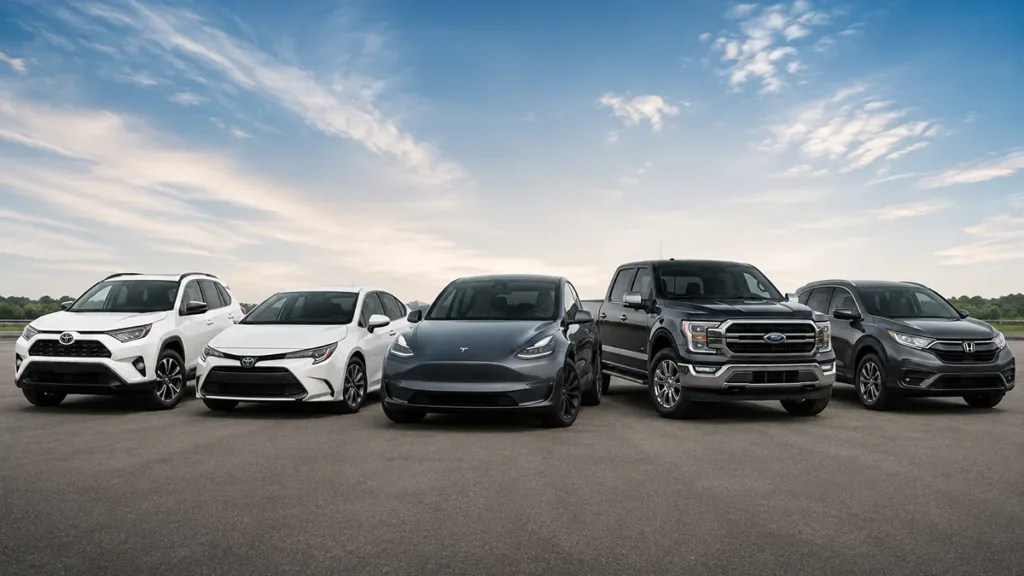
The model-level rankings tell the hybrid story more clearly than anything else.
| Rank | Model | Type | Trend |
| 1 | Toyota RAV4 | Compact SUV | Benefited from hybrid demand |
| 2 | Toyota Corolla | Compact sedan | Consistently strong |
| 3 | Tesla Model Y | Electric SUV | Down 9%–11% |
| 4 | Ford F-Series | Full-size pickup | Boosted by the hybrid F-150 |
| 5 | Honda CR-V | Compact SUV | Strong U.S. hybrid sales |
Note: Reported volumes vary by source, largely because some analysts count regional variants separately.
The Rise of Electric Vehicle Brands
2025 was the year the EV leaderboard changed hands.
According to The Guardian, BYD sold 2.26 million battery-electric vehicles and surpassed Tesla as the global BEV leader for the first time. Vertical integration is a key reason: BYD manufactures its own batteries and controls much of its supply chain, allowing it to offer aggressive pricing that competitors struggle to match.
Exports reached 1.05 million units as BYD expanded into Europe, South America, and Southeast Asia.
Tesla remains the brand that helped make electric vehicles mainstream, but 2025 brought headwinds. Model Y sales fell about 9%–11%, attributed to reduced incentives in key markets, a mid-year production pause for a refresh, and intensifying competition in China.
Other Chinese EV makers continue to climb. Geely Group has more than doubled its global sales since 2020, now sitting at around 4.12 million units across Geely, Volvo, Polestar, and Lotus. SAIC finished close behind BYD in overall volume.
There is a counter-trend worth understanding. Pure EV growth slowed in several markets while hybrid demand accelerated. Toyota’s decision to invest heavily in conventional hybrids, once viewed as overly cautious, appears to have helped the RAV4’s climb to the top spot. Buyers wanted lower running costs without depending on charging infrastructure.
Why These Brands Dominate
Four factors separate the leaders from everyone else.
- Reliability, reputation, and ownership costs. Toyota and Honda built their reputations on vehicles that can reach high mileage while offering manageable maintenance costs. That reputation compounds over decades and shows up directly in resale value.
- Regional specialization. Ford and GM dominate the American full-size truck market so thoroughly that global rankings understate their profitability. A single segment in a single region generates enormous volume.
- Manufacturing integration. BYD’s battery production is the clearest example. Controlling one of the most expensive components in an electric vehicle can provide a cost advantage that marketing alone cannot replicate.
- Distribution scale. Toyota leads sales in more countries than any other brand, ranking as the top brand in roughly 41% of the countries analyzed worldwide. It leads in about 25 major global markets and holds a 10.6% share of total global vehicle sales. Parts availability, service network density, and dealer coverage all follow from that footprint, and they matter more to buyers than most spec comparisons.
What This Means for Used Car Buyers
Global sales rankings are not just industry trivia. They can tell you a lot about what to expect when you’re buying a used vehicle.
Parts availability follows volume. A brand that sells millions of units annually generates a strong aftermarket ecosystem. Replacement components are cheaper, more widely stocked, and available from multiple suppliers. That advantage compounds on high-volume models like the Corolla, F-150, CR-V, and Honda Civic.
Mechanic familiarity follows volume too. Most repair shops in the U.S. are familiar with the RAV4. Fewer have worked on a Polestar. That difference can show up in diagnostic time and labor costs.
Resale value tracks reputation. Toyota and Honda often hold their value better than competitors, which cuts both ways. You may pay more when buying one used, but you can also recover more when selling it.
High-volume models make practical auction purchases. For anyone evaluating salvage or used inventory, the calculation is straightforward: common vehicles have cheaper parts, more donor availability, and broader buyer demand at resale. Our guide on affordable cars under $5,000 covers models that combine low acquisition costs with strong parts support.
Commercial use rewards the same logic. Fleet operators and high-mileage drivers gravitate toward the same handful of models for exactly these reasons, as our overview of the best cars for taxi work explores in more detail.
EV considerations differ. Charging infrastructure, battery replacement costs, and specialist availability all vary by region. An electric vehicle that makes sense in California may be impractical in rural Montana, and that gap is wider than fuel-cost comparisons suggest.
FAQ
Which of the top car manufacturers sold the most in 2025?
Based on the most recent full-year data available, Toyota Group led global sales in 2025 with 11.32 million vehicles, marking its sixth consecutive year at the top. Volkswagen Group finished second at 8.98 million units.
Which EV brand is leading global sales?
BYD. The company sold 2.26 million battery-electric vehicles in 2025, overtaking Tesla for the first time. BYD now accounts for roughly 21% of the global plug-in electric vehicle market despite a minimal presence in the United States.
Is Toyota still one of the most popular car brands worldwide?
Yes. Toyota is the number-one manufacturer by total group volume. The margin narrows considerably when commercial vehicles are excluded, with passenger-only figures placing Toyota at around 8.3 million versus Volkswagen at 8.2 million. Toyota also leads sales in more individual countries than any other brand.
Which car brand has the best resale value?
Toyota and Lexus consistently rank at or near the top of resale value studies, with Honda close behind. Vehicle-specific results vary by model and market, so comparing local sale prices for the exact year and trim gives a more reliable answer than brand-level averages.
Final Outlook: Automotive Trends
The next few years will likely reward manufacturers that kept multiple powertrains in production rather than betting everything on one.
Toyota’s hybrid-heavy strategy now looks more aligned with consumer demand than it did several years ago. BYD’s cost structure gives it room to compete on price in markets where subsidies are shrinking. Legacy manufacturers with strong regional positions, particularly in North American trucks, retain profitable footholds even as global market share shifts.
For auction buyers, the practical takeaway has not changed much. High-volume models from established manufacturers offer advantages in parts availability, service access, and resale value. Those advantages may not be obvious at first, but they can make a real difference over three years of ownership.
Ready to start your search? Explore used vehicles from top brands at AutoBidMaster.
Sources (accessed August 2026):
- JATO Dynamics – Global Vehicle Sales Analysis, 2025
- The Guardian – China’s BYD overtakes Tesla as world’s biggest electric car seller
- Ford Motor Company – 2025 Full-Year Sales Report
- Statista – Best-Selling Car Brands in the World
- Motor1 – United States Best-Selling Vehicles, 2025
- Visual Capitalist – World’s Biggest Carmakers, 2020–2025

- Buying Copart Vehicles in Nebraska: A Private Buyer’s Guide - October 22, 2026
- A 2026 Guide to Copart Auctions in Alaska: Public Access, Fees, and Buying Rules - October 16, 2026
- Ford F-150 Years to Avoid (and the Best Ones to Buy) - October 15, 2026